
Fort Worth Busted Arrest Records
The Fort Worth Police Department posts a Recent Arrests search. FWPD's log covers a rolling fourteen-day window. For a fresh city arrest, nothing official beats it. The log captures the moment city police booked someone. A county record only begins later, if that person moves to the Tarrant County Sheriff's Corrections Center. That lag explains why the arrest time and the county book-in time rarely match. It also explains why searchers who skip the city step often come up empty. FWPD holds no long-term custody facility of its own. Class A and B misdemeanors plus felonies generally mean a transfer to county custody. Others face a magistrate, meaning a judge at an initial proceeding, while still at FWPD. Many post bond before any transfer happens. Class C matters take a different route through Fort Worth Municipal Court and related city channels.
Important: A Fort Worth busted arrest entry only shows a booking event. Check the court file for what happened after that.
Where Fort Worth Busted Mugshots Appear
Each official source answers a different question. The order matters. The FWPD log confirms a recent city arrest. The sheriff's live roster tells you whether someone sits in Tarrant County custody right now. Daily Booked In Reports list everyone entering county custody in dated twenty-four-hour chunks. None of these official text interfaces shows a booking photo. The county posts no online photo-display policy either. So a genuine gap remains for anyone hunting Fort Worth busted mugshots through government channels alone. That gap does not mean no photograph exists.
| Channel | Photo shown? | Status | Best use |
|---|---|---|---|
| FWPD Recent Arrests | No photo seen | Official | Recent Fort Worth arrest and transfer status |
| Tarrant Inmate Search | Unconfirmed | Official | Current county custody |
| Daily Booked In Reports | No photo in reviewed PDF | Official | Recent county book-ins |
| Busted Newspaper Fort Worth tag | May display photos | Unofficial | Secondary lead only, verify with agency records |
| Dallas Express feature | Selected editorial images | Editorial | Monthly, non-exhaustive coverage |
Secondary sites play a different game. The Fort Worth tag on Busted Newspaper and the county-level aggregators sit outside government systems, and they can lag, duplicate, or flatly misstate a record. The Dallas Express feature is selective too; it says its example pulled photos from Mugshots Zone and charges from TCSO Daily Booked In Reports. Useful for mapping the landscape, sure. Still, police, sheriff, and court records remain the path to verification. Why point to FWPD's official Recent Arrests page? Its date-limited search is the city-level starting point, and the result fields plus transfer status tell you whether a Tarrant County custody check is the sensible next move.
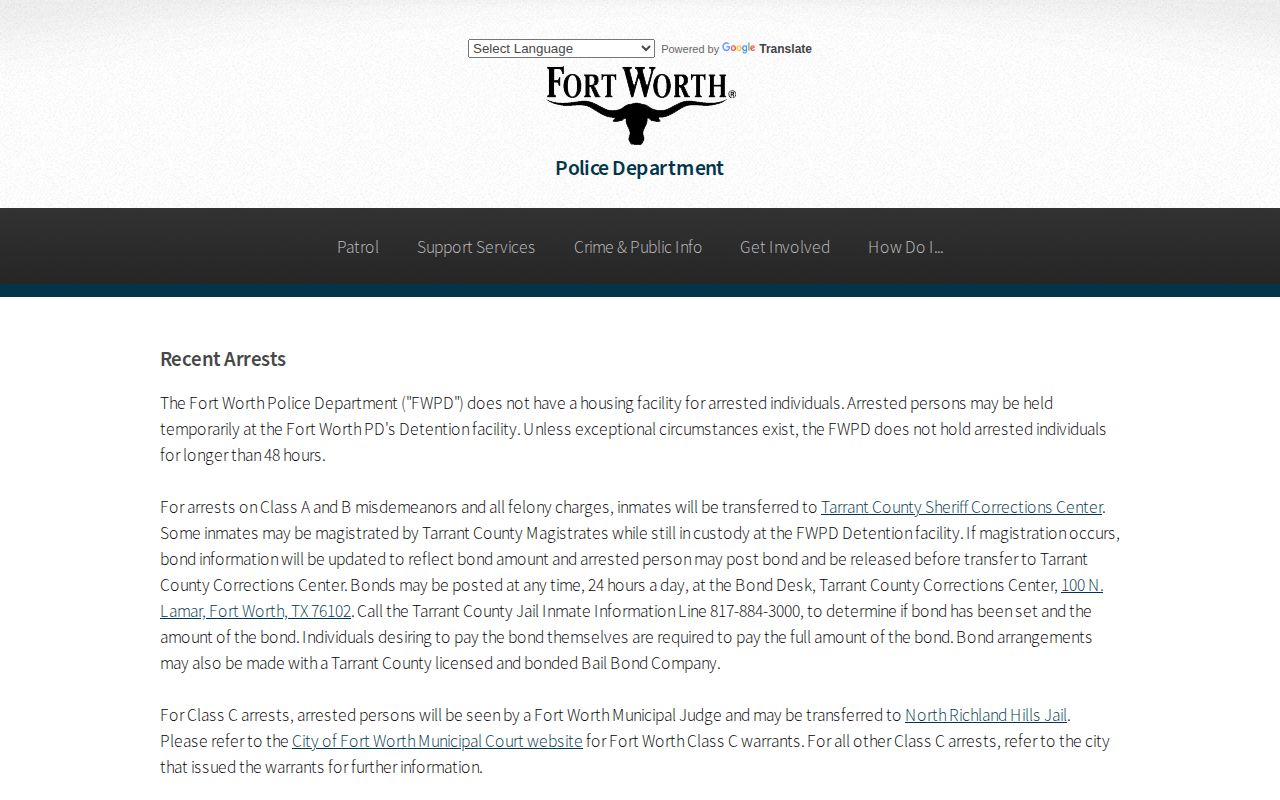
What you see on the official screen is a city arrest-search interface, not a gallery of booking photos. Match any result by its report or booking number before filing a records request.
Fort Worth Arrest Log Fields
The FWPD search takes a first and last name and looks back fourteen days. A typical result carries plenty. Name, race, sex, and age come first. Then booking date and time, report number, booking number, charges, and a status field. Those two numbers are your best identifiers when the name is common. Race and sex help separate similar records. They prove nothing about identity on their own. Status drives everything. A transfer to Tarrant County Jail points you toward the live Tarrant County Inmate Search. Add the dated booked-in reports for a recent county entry. Someone who posted bond before transfer may show up in neither. Class C matters can stay on the municipal path entirely. A blank roster result never rules out that an arrest happened.
- Booking number
- An identifier assigned to the booking event that can help locate a specific request.
- Report number
- The police event number that helps FWPD Records identify the related report.
- Status
- A recorded custody or transfer condition, not a final case outcome.
- Disposition
- The court’s eventual resolution of a case, which is different from a booking charge.
Busted in Fort Worth Lookup Route
A fresh Fort Worth arrest can bounce from city log to county record fast. Grab the exact city entry first. Then pick your next source from its status field and the time elapsed. For the fuller county-wide picture of roster fields, rolling report windows, and record requests, see the Tarrant County booking lookup.
- Search the FWPD Recent Arrests log by the person’s last and first name within its available fourteen-day window.
- Record the displayed booking time, report number, booking number, charges, and status without treating the charge as a conviction.
- If the status indicates a county transfer, search the Tarrant current-custody roster with the narrowest known identifiers.
- Check the Daily Booked In Reports for the relevant dated twenty-four-hour period when a recent county book-in is expected.
- Use FWPD Records for the city report and TCSO Records for a responsive county booking record or photograph.
The county feed runs from day one through day fourteen. Each is a separate twenty-four-hour report, not one complete history. The live roster is its own current-custody animal. A name can show in a dated county report yet vanish from the live roster after release or transfer elsewhere. Daily Bond Reports track bond activity. They offer no photos. They settle nothing about the case itself. Note: Save the report number, booking number, official URL, and retrieval date whenever a timeline may need checking against a court file later.
Fort Worth County Transfer Records
City logs have a short shelf life. Once a Fort Worth arrest moves into county hands, the sheriff's tools matter more than anything FWPD posts downtown. Start with the Tarrant County Inmate Search, which lets you query by last name, first name, CID, race, and sex. A typical result returns the CID, the person's name, physical descriptors, and whether they're currently held. What it doesn't give you is a booking photo through the text interface, so don't count on a mugshot here.
For a quick view of recent book-ins, the Daily Booked In Reports work well. Day one is the newest, and days two through fourteen give you a rolling two-week window. Each entry lists a name, CID, book-in date, booking number, and a charge or description. Handy after a transfer from the city side. Keep in mind the reports are a snapshot, not history: someone released yesterday may already be off the roster, even though the agency's underlying record still exists and can be requested.
Later, case status lives elsewhere. The Tarrant Odyssey public-access search covers court records, searchable by party name or case number. Class A and B misdemeanors run through the County Clerk, while felonies route to the District Clerk. No mugshots on this path, but a court file answers the question that actually matters down the line: how the case ended.
Fort Worth Police Booking Records
For a specific Fort Worth police report or any photo FWPD holds, go through FWPD Records rather than the public arrest log. No booking-photo fee or guaranteed response time is published. Keep the request narrow. Give the person's name, the date, a report or booking number, the charge, and a clear description of the record or image you want. If the record came from county custody, TCSO Records is the right custodian instead.
The FWPD contact page lists the department's main line and a non-emergency line, but report requests go through Records. TCSO Records takes sheriff booking record and booking photo requests via justfoia.com/publicportal">JustFOIA, email, mail, or an in-person visit. Ask for a specific event. Do not ask the agency to assemble someone's entire history.
Texas public-information rules shape what gets released and what gets withheld. The county asks for detail and may send a cost estimate once fees pass its stated threshold. No Fort Worth booking-photo price appears anywhere in its guidance, so assume no figure.
Fort Worth Busted Coverage Limits
Fort Worth news is event-driven. No outlet runs a citywide booking list. The Star-Telegram crime section is the strongest local hub and covers Fort Worth regularly. FOX 4, NBC 5, and the Dallas Morning News also pick up selected incidents. Their photos may come from agencies, reporters, or third parties, and none of it substitutes for a police log, jail roster, or court file.
Dallas Express runs a monthly feature that highlights a small set of arrests. It credits booking photos to Mugshots Zone and charges to TCSO reports, which tells you it's an editorial product rather than an official feed. One article a month skips most city arrests, and a story can linger online long after custody or charges change. For the wider media picture plus the official record path behind any story, see the county's Arrest News coverage.
Sites like Recently Booked, Mugshots.com, Arrests.org, Mugshots.zone, and Muglist fill the county-level secondary market. None of them is authoritative on identity, current custody, or case outcome. Booking status shifts. Skip the outside listing and check the named agency or the right court record.
Fort Worth Court Record Status
Arrest records answer one narrow question. They show what happened at a police event. Court records answer a different one: was a case ever filed, and how did it end? The clerk depends on the charge. Class A and B misdemeanors sit with the Tarrant County Clerk, while felonies go through the District Clerk. Odyssey offers a public search once you select criminal cases.
Never read a court result into an empty roster, a bond event, or an old news story. A bond can free someone while the case moves forward. A transfer can shift which office holds the current facts. Court disposition is where the matter gets tested and settled, so keeping these records straight stops a recent Fort Worth arrest from becoming a shaky conclusion.
Note: When agency and court records show different dates, keep both, since a police arrest, a county booking, and a court filing are three separate events.